Service
Orthodontics
Tooth alignment with fixed appliances or clear aligners.
Traditional and invisible orthodontic treatments tailored to the individual case.
Sections
03
Information blocks
FAQ
02
Frequently asked questions
Links
02
Related services
What this page covers
The sections reuse the existing local content and keep the reading order clear without adding new claims.
- 01
Traditional orthodontics
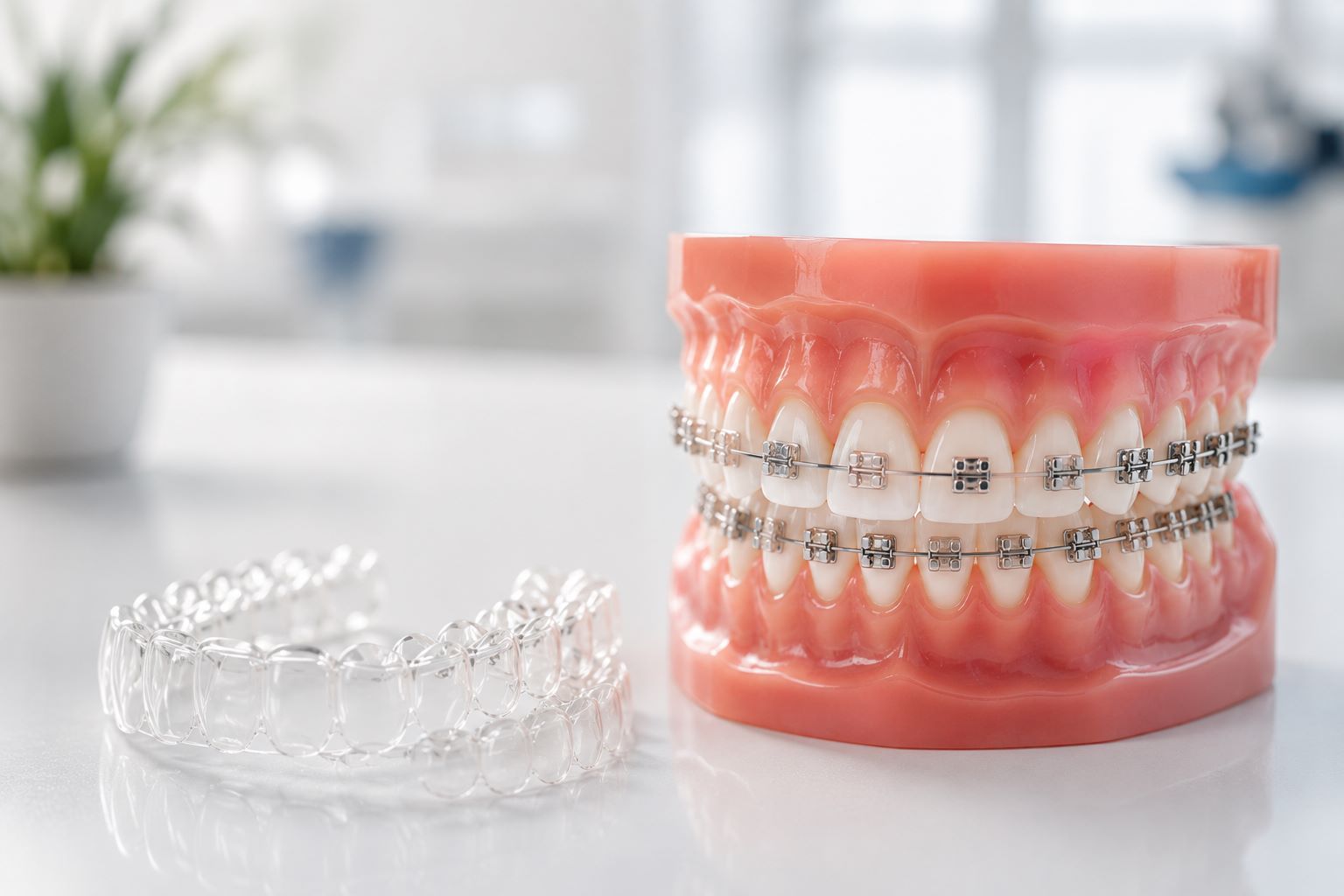
Fixed appliance with brackets and metal wires
- 02
Invisible orthodontics
Clear aligners
- 03
Choosing the treatment
The solution depends on the clinical case
Key content
Main treatment blocks.
Each card uses the existing catalog data to keep the page clear, stable, and readable on desktop and mobile.
Traditional orthodontics
Fixed appliance with brackets and metal wires
Fixed orthodontics uses brackets and metal wires to apply forces that move the teeth; it is often more effective for complex movements and significant malocclusions.
- May be more effective in complex cases.
- Makes tooth movements more controllable.
- Usually requires more frequent adjustment visits.
Invisible orthodontics
Clear aligners
Clear aligners are discreet plastic trays that are comfortable and easy to clean; they offer greater dietary freedom, but they may not be effective for every complex case.
- More discreet than fixed braces.
- Easy to clean and manage in daily routines.
- Not always the best solution for complex cases.
Choosing the treatment
The solution depends on the clinical case
Traditional and invisible orthodontics are both valid options: the choice should be built around the individual patient, balancing movement complexity, aesthetics, and comfort.
Frequently asked questions
Essential answers for orientation.
The static Q&A cards stay accessible without JavaScript and only use the service content already stored in the catalog.
Is one orthodontic option always better than the other?
No. The choice depends on the clinical case, movement complexity, and the patient needs.
Are clear aligners less visible?
Yes, they are designed to be more discreet than fixed braces and are often easier to fit into daily life.
Related services
Related pathways to consider together.
The links use the services already present in the local catalog and open their dedicated pages.
Dental aesthetics
Improvement of the smile appearance through conservative and aesthetic treatments.
Whitening, veneers, crowns, and targeted cosmetic reconstructions.
Open service
Oral hygiene and prevention
Professional cleaning sessions and personalized prevention plans.
Plaque and tartar removal, typically recommended once or twice per year.
Open service